
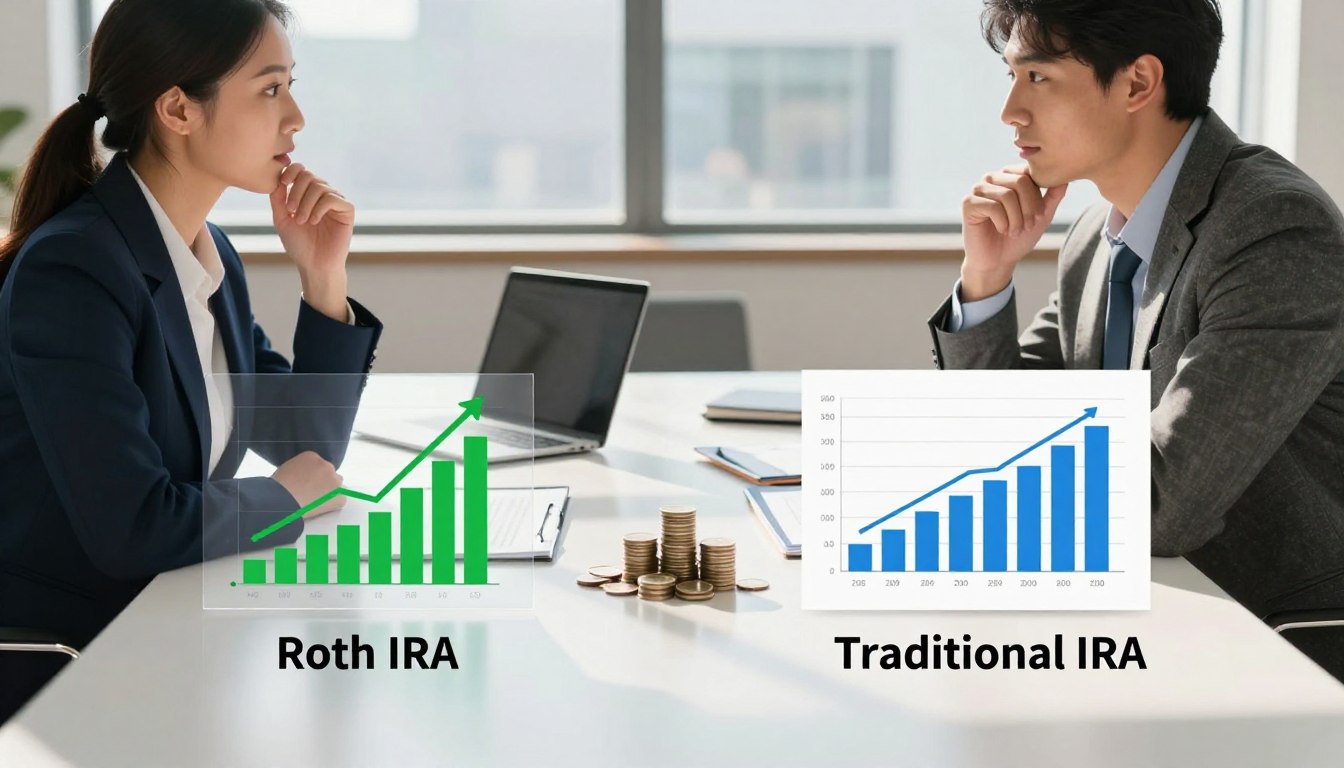
Choosing the right IRA can shape your long-term retirement security. This intro lays out the key ideas you need to weigh now so you can build a clearer plan for the future.
Start by thinking about tax timing and your expected income in retirement. A roth ira grows tax-free, while a traditional ira often gives tax breaks now. Each path affects your take-home pay decades from now.
Also, read fund documents carefully. If you look at Vanguard mutual funds, review the prospectus to learn goals and risks. Target Retirement Funds that Vanguard offers shift from aggressive to conservative as the target date nears. That glide path matters for risk and returns.
Align any account choice with your timeline, risk tolerance, and long-term savings goals. Get the right information, compare scenarios, and pick the option that supports steady growth and financial stability in the United States.
Key Takeaways
- Tax treatment and timing shape long-term outcomes.
- Review Vanguard prospectuses to understand objectives and risks.
- Target Retirement Funds move from aggressive to conservative as the date approaches.
- Match account choice to your timeline and risk tolerance.
- Clear planning helps protect retirement savings over decades.
Understanding the Difference Between Roth IRA and Traditional IRA
How you pay taxes on contributions shapes how much you keep later. A roth ira uses after-tax contributions so qualified withdrawals are tax-free. A traditional ira often gives a tax break now, with taxes due on withdrawals.

Choose the path that fits your expected tax situation. If you expect a higher tax rate in the future, tax-free withdrawals can help. If you need the upfront deduction today, the other route may suit you better.
- Tax timing: pay now or pay later affects total value.
- Compare your current tax bracket to your expected bracket in retirement.
- Consider how each account affects long-term earnings and growth.
Both options help people save for the future, but they offer unique benefits for different situations. Use simple projections to see which path may leave you with more after-tax income in retirement.
How Traditional IRA Accounts Function
Traditional accounts let your investments grow now while you delay paying taxes until retirement. This structure lets earnings compound without yearly tax drag, which can boost long-term balances.
Tax-deferred growth means you do not pay taxes on gains until you withdraw funds. Many traditional iras also offer an immediate tax benefit because contributions are often deductible. That lowers your taxable income for the current year.
When you take distributions in retirement, withdrawals are taxed as ordinary income based on your bracket. Understanding these tax rules helps you plan how much money you can keep after taxes and when to withdraw.

- Grow tax-deferred: gains compound without annual tax payments.
- Immediate relief: possible deduction reduces current tax burden.
- Tax at withdrawal: distributions taxed as ordinary income.
| Feature | How It Works | Impact |
|---|---|---|
| Tax treatment | Contributions may be deductible; gains tax-deferred | Lower current tax bill; taxes due later |
| Growth | Investments compound without yearly taxation | Potential for larger balance at retirement |
| Withdrawals | Distributions taxed as ordinary income | Plan withdrawals to manage tax bracket |
Key Features of Roth IRA Accounts
A clear look at how after-tax funding changes your long-term payout helps you pick the right retirement path.

Tax-Free Growth
roth ira balances grow without annual tax drag, so earnings compound more efficiently over time.
Qualified withdrawals of earnings are tax-free if you meet two rules: the account has been open at least five years and you are age 59½ or older.
After-Tax Contributions
A roth ira is funded with after-tax contributions, so you do not get an immediate tax deduction for the money you invest.
Because you already paid tax, your earnings can be withdrawn tax-free in retirement. You may also take out your original contributions at any time without taxes or early penalties.
- Contributions are not deductible now but offer tax-free withdrawals later.
- Many investors favor roth iras if they expect higher future tax rates.
- Meet the five-year and age rules to secure tax-free treatment of earnings.
Comparing Tax Treatment and Deductibility
Picking when to settle taxes can change the size of your nest egg at retirement. The core choice is whether you want to pay tax on contributions now or let the IRS collect on withdrawals later.
Traditional accounts may offer a current-year deduction for eligible contributions, lowering taxable income today. That immediate relief helps some savers reduce their tax bill in higher-earning years.
By contrast, roth traditional contributions are made with after-tax dollars. That means no upfront deduction, but qualified withdrawals can be tax-free in retirement.

Decide by comparing your present tax bracket with your expected future bracket. If you think rates will be higher later, paying tax now may be wise. If you need relief today, the other route can help.
- Timing matters: Taxes paid now versus later changes take-home income.
- IRS treatment: The account you pick controls how withdrawals are taxed.
- Practical tip: Talk to a tax pro or use projections — and see resources like independent contractor guidance for related planning.
Annual Contribution Limits and Income Restrictions
Annual contribution caps and income rules shape how much you can set aside each year.

Your modified adjusted gross income and filing status determine how much you may contribute. For many savers, knowing the current limits helps avoid excess contributions and penalties.
Income Limits for Roth IRAs
High earners face phase-outs based on their adjusted gross income and MAGI. These income limits reduce the allowed contribution amount as MAGI rises.
Always check the year’s thresholds before you make an IRA contribution. If you exceed the cutoff, direct contributions may be limited or disallowed.
Deductibility for Traditional Accounts
For the 2025 tax year, full deductibility for a traditional account is available to covered individuals with a MAGI of $126,000 or less when filing jointly.
Contribution rules and deductibility can change. For 2025 the standard limit for ira contributions is $7,000 with a $1,000 catch-up for older individuals.
For 2026, the standard contribution amount rises to $7,500 with a $1,100 catch-up for those 50 and older.
| Year | Standard Contribution | Catch-up |
|---|---|---|
| 2025 | $7,000 | $1,000 (age 50+) |
| 2026 | $7,500 | $1,100 (age 50+) |
| Deductibility note | Full deductibility for covered individuals with MAGI ≤ $126,000 (filing jointly) in 2025 | |
Practical steps:
- Compare your adjusted gross income to published thresholds before contributing.
- Track your total ira contributions each year to avoid excess amounts.
- Use reliable guidance on savings strategies, such as the best way to save money, to plan contributions wisely.
Navigating Withdrawal Rules and Penalties
Knowing withdrawal rules helps you protect your retirement savings. Taking withdrawals early can trigger ordinary income tax and a 10% federal penalty if you are under age 59½.
Some exceptions let you access funds without the penalty. These include qualified higher education costs, a first-time home purchase (up to $10,000), and birth or adoption expenses (up to $5,000). Still, the withdrawal may be subject to tax.

“Plan carefully before tapping retirement accounts; small mistakes can cost thousands in tax and penalties.”
Practical tips: Be cautious with your money and follow the rules closely. If you need early access, talk with a tax advisor to confirm penalty-free status for your case.
| Action | Consequence | Notes |
|---|---|---|
| Early withdrawal (under age 59½) | Ordinary income tax + 10% penalty | Common rule for most IRA distributions |
| Higher education | No 10% penalty (tax may apply) | Qualified expenses only |
| First-time home purchase | No 10% penalty for up to $10,000 | Lifetime limit applies |
| Birth or adoption | No 10% penalty for up to $5,000 | Use within required time frame |
Understanding Required Minimum Distributions
Reaching the IRS age threshold triggers required payouts from some retirement accounts. These rules affect how you plan cash flow and tax timing as you grow older.

Impact of Age on Distributions
Once you reach age 73, most traditional retirement accounts must start sending money out. The law requires required minimum distributions to ensure funds are taxed while you are alive.
The required minimum distribution amount is based on your account balance and your life expectancy, as set by federal tables. Use the published divisor to calculate the required minimum for each year.
Missing an RMD carries steep consequences. Failing to take your rmds on time can trigger a heavy penalty and additional tax on the amount that should have been withdrawn.
By contrast, some accounts do not force withdrawals during the owner’s lifetime. A roth-style ira has no minimum distributions for the original owner, offering more flexibility in retirement planning.
- Age 73 rule: traditional account holders must begin required minimum distributions at this age.
- How amounts are set: calculations use your year-end balance and life-expectancy factor.
- Tax impact: distributions are taxed as ordinary income when withdrawn.
- Penalty risk: missed rmds can lead to a large excise tax on shortfalls.
- Planning tip: manage withdrawals to control tax brackets and protect long-term savings.
Strategic Considerations for Roth Conversions
A conversion can make sense when you expect higher taxes on retirement income.

Converting a traditional ira to a roth ira triggers a current tax bill. That tax is due in the year you move funds. Plan for that cost so the conversion does not erode your investment gains.
Backdoor moves let high earners place money into a roth-style account when direct contributions are limited. This process uses non-deductible contributions and a timely conversion to reach the tax-free account.
Talk with an advisor before you act. A qualified advisor can model tax outcomes and show if a conversion fits your retirement plan. They can also check whether your portfolio can absorb the immediate tax hit.
“A conversion is a tax decision as much as an investment choice—treat it that way.”
- Convert if you expect a higher future tax bracket.
- Confirm you have cash to pay taxes now, not from the account you convert.
- Use a backdoor roth path only with clear tax guidance.
| Action | Primary Effect | When It Helps |
|---|---|---|
| Convert traditional ira to roth ira | Pay taxes now; tax-free withdrawals later | Expect higher taxes in retirement |
| Backdoor roth strategy | Allows high earners to fund roth account | Income exceeds direct contribution limits |
| Consult a financial advisor | Models tax impact and timing | Complex tax situations or large balances |
For help estimating how much to save now and how conversions affect your plan, see this practical guide on how much of your paycheck to save: how much of your paycheck you should.
Factors to Consider Before Choosing Your Account
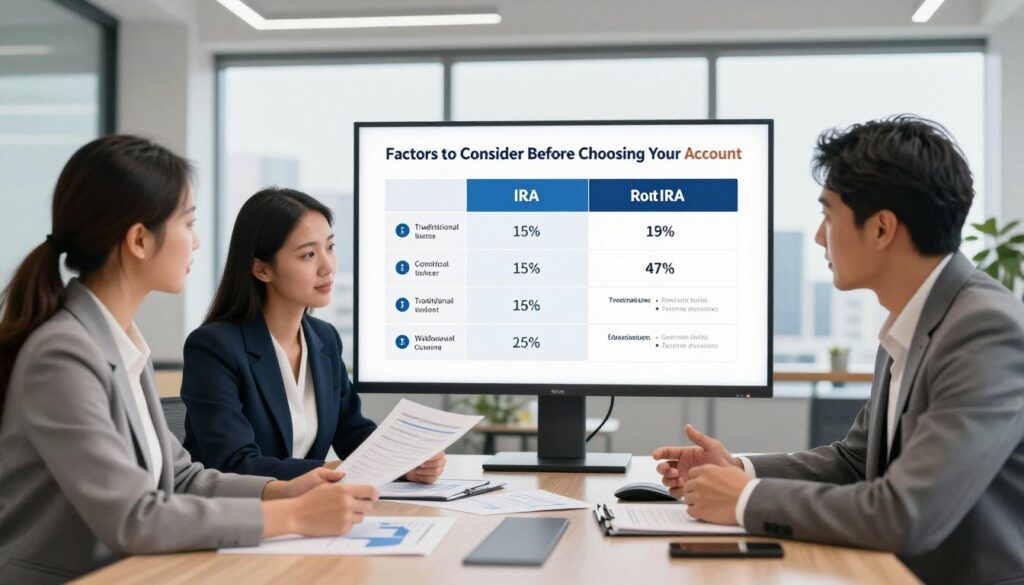
Start by checking current income and expected tax bracket in retirement. Your filing status and modified adjusted gross income (MAGI) affect who qualifies for full deductibility when filing jointly.
Review the latest contribution limits and income limits each year. Track how many contributions you plan to make and the total amount you can set aside.
Think about investment goals. If you need tax relief now, one account may help. If you prefer tax-free withdrawals later, the other might suit your plan. Use estimates for earnings and distributions to compare outcomes.
- Compare your MAGI to published thresholds before contributing.
- Factor in age and potential rmds when planning withdrawals.
- Consult an advisor to model taxes and savings paths.
“Small choices now—how much you save and when you pay taxes—shape your long-term retirement wealth.”
For practical savings steps and clear savings guidance, consult trusted information and a financial advisor before you act.
Conclusion
A clear contribution plan helps you control future taxes and grow savings more effectively.
Choosing a roth ira or a traditional ira is a pivotal step for steady retirement income. Know the rules for contributions, withdrawals, required minimums, and conversions so you keep more of your money.
Check your modified adjusted gross income and filing status each year to stay inside the contribution limits. Track withdrawals and rmds to avoid penalties and manage your tax bracket in retirement.
When in doubt, consult a financial professional. For related ideas on supplementing savings, explore passive income streams that can boost income and help meet long-term goals.
FAQ
What are the main tax and withdrawal distinctions for Roth versus traditional retirement accounts?
How do adjusted gross income and modified adjusted gross income affect eligibility and limits?
What are current annual contribution caps and how do filing status and age matter?
When do required minimum distributions start and how do they work?
Can I convert a pretax account to an after-tax account, and what are the tax consequences?
Are there penalties for early withdrawals and what exceptions exist?
How do workplace retirement plans affect deductibility of contributions?
What should I consider when deciding which account type fits my retirement strategy?
How do earnings, investment choices, and account rules affect long-term growth?
What is the impact of filing jointly on contribution eligibility and phaseouts?


