

This short guide shows how to use email marketing to drive sales today for small and larger businesses in the United States.
You’ll get a clear, step guide getting started: build a quality list, segmenting email list, and choose campaign type that will help accomplish goals rather than add noise.
The piece explains where this channel fits inside your overall marketing strategy and how to determine campaign type — welcome emails, newsletter emails, promotional, nurturing, or reengagement — based on customer journey stage.
We also cover how to choose an email marketing platform, craft subject lines and create email copy that converts, and ethical ways to build email list momentum using your website and social media.
For practical prompts and sales-focused examples, see this prompt guide for sales to speed setup and testing.
Key Takeaways
- Follow a step-by-step path from list building to sending the right campaign type.
- Match campaign type to customer journey: welcome, newsletter, promo, nurture, reengage.
- Choose a platform that scales and supports subject lines, segmentation, and testing.
- Keep messages scannable and mobile-friendly to improve conversion.
- Use ethical list growth via site and social media to protect deliverability and trust.
Why email marketing remains one of the most effective channels today
Owning a direct line to customers cuts through feed volatility and makes ROI easier to measure. Direct inbox messages bypass algorithm shifts and rising ad costs, giving predictable reach and clear metrics.

Benefits of good email for long-term customer loyalty
Good email compounds value over time. Consistent, relevant messages reduce churn and increase repeat purchases.
Compared with social media, you control audience data and can build email list assets you own. That resilience matters in any marketing strategy.
- Lifecycle campaigns keep customers active from onboarding to retention.
- Useful content—how-tos and customer stories—drives regular opens and action.
- Measured engagement helps sales find high-intent subscribers faster.
“Treat email as a relationship, not a blast channel.”
| Advantage | What it does | Impact on loyalty | Metric to watch |
|---|---|---|---|
| Direct reach | Delivers messages to inbox | Builds trust | Open rate |
| Owned list | Protects customer data | Increases lifetime value | Repeat purchase rate |
| Lifecycle flows | Nurtures stages | Reduces churn | Retention rate |
How to choose an email marketing platform that fits your goals
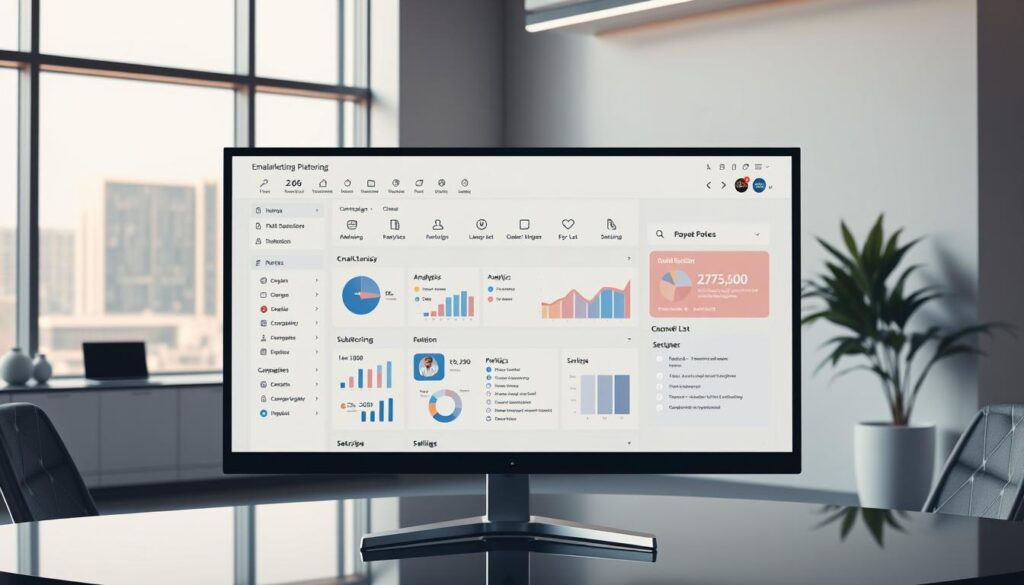
A strong choice hinges on matching core features to real needs: segmentation, automation, and analytics that tracks many people who open, click, and convert.
Essential features to prioritize
Start by defining must-haves: intuitive segmentation, reliable automation, and clear reporting. These let you compare providers on capability, not hype.
Look for: tags and behavior-based segments, native forms, preference centers, and automation builders with branching logic and triggers.
Integrations and deliverability
Evaluate how the marketing platform syncs with Shopify, Salesforce, HubSpot, or WooCommerce. Confirm DKIM/SPF setup help, spam testing, and inbox placement tools.
When you may want an enterprise solution
For complex data models, multi-brand orchestration, or strict governance, you may want an enterprise tool like Adobe Campaign. It centralizes messaging and supports deep data operations.
| Need | Small Business | Mid-Market | Enterprise |
|---|---|---|---|
| Segmentation depth | Basic tags & lists | Behavioral segments | Advanced audience models |
| Automation | Prebuilt flows | Branching logic | Cross-channel orchestration (e.g., Adobe Campaign) |
| Reporting | Open/click reports | Cohorts & revenue | Custom dashboards & attribution |
Pilot two platforms with a small campaign to validate workflow, QA, and sending speed. Ensure your pick scales so you don’t outgrow your platform six months in.
Email marketing compliance in the United States
Follow clear legal steps to keep your sends compliant while protecting deliverability and trust.

Understanding the CAN-SPAM Act and practical compliance steps
The CAN-SPAM Act requires honest subject lines, a clear sender identity, a valid postal address, and a working unsubscribe link in every message.
Honor opt-outs within 10 business days and never transfer opted-out addresses to other lists. Keep separate sender domains or IPs for transactional vs. promotional traffic to protect critical notices.
Permission, unsubscribe, and data practices that build trust
Consent-based practices still win. Even though the CAN-SPAM Act allows commercial sends without opt-in, using permission improves deliverability and trust.
- Collect minimal data and store it securely.
- Enforce a compliance checklist for each marketing campaign: consent capture, suppression lists, footer compliance, and plain identity lines.
- Provide preference centers so subscribers can choose frequency or topics.
| Requirement | Action | Why it matters |
|---|---|---|
| Unsubscribe link | Visible in every message | Legal compliance; lowers complaints |
| Opt-out timing | Honor within 10 business days | Protects deliverability |
| Data handling | Limit collection; audit access | Reduces breach risk |
Build an email list the right way
Begin with a single, relevant promise on your website—deliver value first, ask for contact next. Offer a short step guide getting a result, a template, or a timed discount so visitors know why to join your email list.

Guide to getting started with ethical list growth on web and social media
Place concise forms where intent is highest: hero, mid-article, and exit intent. Keep fields lean so visitors can sign up fast on mobile.
Use ethical tactics on social media—tease a lead magnet, run event signups, or share content previews to build momentum without buying contacts.
Within your email list: capture data you’ll use later
Ask only for essentials up front, then use progressive profiling to enrich profiles over time. Capture interests, product categories, or company size so segmentation helps personalize, not hinder.
Set expectations: frequency, themes, and data use. Deliver the promised asset instantly and follow with a welcome sequence that shows value from day one.
- Tag sources: web, social, events, partners to measure quality.
- Test monthly: A/B subject, placement, and incentives to improve growth.
- Consider double opt-in: higher intent and better sender reputation.
| Action | Where | Why it matters | Quick tip |
|---|---|---|---|
| Value offer | Website hero | Boosts conversion | Use a step guide getting results |
| Lean form | Mobile & blog | Lower friction | One or two fields |
| Source tagging | Sign-up form | Track channel ROI | Tag web, social media, events |
| Welcome flow | After sign-up | Sets expectations | Deliver asset instantly |
For step-by-step setup on your site, see this quick guide to make a website at how to make a website.
Segmenting your email list to accomplish goals
Segmenting your list makes each message feel personal and moves subscribers toward clear outcomes. Start by slicing data by behavior (opens, clicks, purchases), demographics (role, industry, location), and lifecycle stage (new, active, at-risk).

Behavioral, demographic, and lifecycle segments
Map segments within email list to outcomes: trial activation, repeat purchase, or referral. Build product-interest groups from clicks on category or feature links to tailor recommendations.
Lead scoring and reengagement segments
Use engagement scoring that tracks many people across actions to prioritize sends. Flag reengagement segments—no opens in 60–90 days, lapsed buyers, or dormant trials—and craft targeted reengagement emails with strong value props.
- Route hot leads: blend firmographic and behavioral signals to send to sales.
- Protect experience: exclude recent purchasers from heavy promos and serve onboarding or loyalty content instead.
- Measure wisely: review many different metrics per segment—CTR, conversion, revenue per send—to find fast wins.
Keep rules simple and auditable so teams can maintain automations. Refresh segment definitions quarterly to match new products, seasonal shifts, and content themes.
For prompts that speed testing and segmentation experiments, try this best ChatGPT prompt.
Define your email marketing strategy before you send
Clarify purpose first. Tie each send to a single business objective—acquisition, activation, revenue, or retention. This keeps creative choices and measurement aligned with outcomes and helps your team focus on what moves the needle.

Determine campaign type based on customer journey
Map messages to moments: welcome for new subscribers, onboarding for new users, promotional for active buyers, and win-back for inactive contacts. Use this mapping to determine campaign type and avoid sending the wrong message at the wrong time.
Setting objectives and many different metrics that matter
Set SMART goals and choose many different metrics to judge quality, not just volume. Track delivery rate, opens, clicks, conversion, revenue per recipient, and unsubscribes.
- Translate goals into hypotheses: what message, offer, and timing will move the segment to the next milestone.
- Schedule a simple calendar that sequences campaign type around seasonality, launches, and lifecycle stages.
- Document a campaign brief: audience, objective, value prop, CTA, measurement plan, and follow-up actions.
Guardrails matter: limit frequency, prevent audience overlap, and align reporting with your wider marketing strategy so stakeholders can see how each email marketing campaign contributes to pipeline and revenue.
For sharper copy that helps accomplish goals, review this sales copywriting guide.
Types of marketing emails you can use
Different message types move subscribers through the funnel by matching content to intent.

Welcome emails and onboarding sequences
Welcome emails set expectations and deliver the promised asset fast. Pair them with short onboarding sequences that highlight key first-use moments.
Ask for a first micro-conversion—profile detail, product preference, or a quick reply—to build rapport and improve segmentation.
Newsletter emails that deliver consistent value
Newsletter emails should teach and inform, not just pitch. Include curated insights, product notes, and community highlights to keep subscribers returning.
Lead nurturing emails that move prospects to purchase
Use nurturing emails to educate with problem-solution content and case studies. Clear proof points reduce buying anxiety and nudge toward action.
Reengagement emails to win back inactive subscribers
Reengagement emails use fresh hooks—new features, special content, or preference checks—to revive dormant readers without spammy tactics.
“Craft subject lines that promise clear value and match the message inside.”
| Type | Primary goal | Key element |
|---|---|---|
| Welcome & Onboarding | Activate | Immediate value + micro-conversion |
| Newsletter | Engage | Consistent, helpful content |
| Lead Nurture | Convert | Case studies & problem-solution |
| Reengagement | Reactivate | Strong hook + preference update |
Create email content that converts
The best messages earn attention fast by promising a clear benefit in the subject line and delivering it within the first sentences.
Subject lines that get opens without clickbait
Write subject lines that lead with value and relevance. Use specifics, benefits, or a gentle curiosity hook without deception to protect trust and deliverability.
Preheaders should extend the promise—think of them as a second headline that boosts open rates rather than repeating the subject line.
Good copy, CTAs, and design that make sure your message is clear
Keep copy concise and scannable. Front-load the “why care” and use short subheads and bullets so busy readers grasp the point fast.
Use one primary CTA per email campaign to reduce decision friction. Place it above the fold and repeat near the end for skimmers.
Design for mobile-first: 14–16px body text, tappable buttons, strong contrast, and accessible structure. Make sure images include alt text and blocks read logically when CSS is stripped.
- Personalize with restraint — name, recent behavior, or interest-based blocks that feel helpful, not intrusive.
- Borrow voice-of-customer language from replies, reviews, and social media to increase resonance.
- Place social proof near the CTA: ratings, logos, or short testimonials reduce perceived risk.
- Keep compliance front of mind: clear sender name, recognizable address, and an unsubscribe link in the footer.
- Maintain a swipe file of high-performing subject lines and layouts to speed future production.
For a short guide on persuasive sales copy that pairs with these tactics, review this writing a sales letter.
Test, learn, and optimize your email campaigns
A steady cycle of tests and learnings turns guesswork into predictable gains. Use controlled experiments to answer one question at a time and apply the result across your flows.
A/B testing different versions to see what works
Set up A/B tests that isolate a single variable—subject lines, CTA copy, or hero image—so different versions produce clear learnings. Document different versions see performance in a shared log for team use.
How to test frequency, send time, and content
Test send cadence to balance momentum and fatigue. Monitor unsubscribes and complaints as guardrails while you test email timing by segment and time zone.
Using many different metrics to improve future campaigns
Track clicks, conversions, average order value, and revenue. Connect analytics that tracks many people across sessions and devices. Use a holdout group to measure true incremental lift.
- Quarterly roadmap: prioritize tests tied to strategy.
- QA checklists: seed inboxes for Gmail, Outlook, and Yahoo.
- Automation: let your marketing platform auto-promote winners and retire losers.
| Test area | Goal | Success metric |
|---|---|---|
| Subject lines | Improve opens | Open rate |
| Send time | Increase engagement | Click rate |
| Content length | Boost conversions | Conversion rate |
affiliate tools can speed setup and reporting when you scale tests across your programs.
Automations and journeys that scale results
Automated journeys turn single sends into ongoing revenue engines that work while your team focuses on growth.
Build always-on automations—welcome, onboarding, post-purchase, and reactivation—to compound results beyond one-off blasts.

Using automation for lead nurturing and customer loyalty
Use automation to deliver lead nurturing emails that teach, answer objections, and pass hot prospects to sales when engagement peaks.
Keep subject lines consistent across each flow so recipients recognize the value and open more often. Automate post-purchase thank-yous, tips, and milestone notes to build customer loyalty.
Trigger-based flows you can set up today
Start simple: new-subscriber welcome, browse or cart abandonment, product education milestones, and renewal reminders. Personalize triggers from your email list and site analytics for timely relevance.
- Route high-engagement signals to a sales queue.
- Prune steps that underperform and iterate like a live marketing campaign.
- For complex, cross-channel needs you may want enterprise tooling like Adobe Campaign to orchestrate at scale.
“Automations free your team to focus on strategy while journeys handle the routine, repeatable work.”
Include preference management and compliance in every automated email campaign. Align automation goals with KPIs so use email marketing supports net revenue retention, not just clicks.
For a quick start, grab a free automation checklist to map your first always-on flows.
Conclusion
Prioritize outcomes over volume: design each send to help accomplish goals while protecting trust.
Start with a solid subscriber base, clear segmentation, and a documented email marketing strategy so every campaign has a measurable purpose. Keep your toolkit simple and scale only when the use case is clear — sometimes you may want a more advanced platform.
Measure what matters and iterate: small wins in copy, timing, and targeting compound. Use consent, clear expectations, and easy preference controls to preserve deliverability and brand trust.
Good content is human and helpful. Close the loop by tying each email marketing campaign back to revenue and customer outcomes so stakeholders see real impact.
FAQ
What is the fastest way to start building a high-quality subscriber list?
How do I decide which campaign type to send to a given audience segment?
What core features should I prioritize when selecting a marketing platform?
How can I stay compliant with U.S. laws while growing my list?
What segmentation tactics drive the most measurable results?
How many metrics should I track to evaluate campaign performance?
What types of automated journeys should I implement first?
How do I craft subject lines that drive opens without being misleading?
What testing approach yields reliable learnings?
When should a business consider upgrading to an enterprise solution like Adobe Campaign?
How can I grow long-term loyalty without over-mailing subscribers?
What are the essential steps to ensure good deliverability?


