

Putting $10,000 into action can change your financial path. A well-planned deposit has time on its side and may compound into a larger sum over years. Start with clear goals and a realistic view of risk.
Research and discipline matter. Learn basics about stocks, bonds, and funds before you move cash. Managing your money means balancing growth goals with market ups and downs.
When you decide to invest 10,000, pick a strategy that fits your experience and timeline. Focus on asset mix, fees, and simple steps you can follow. Consistency and patience help investing work in your favor.
Key Takeaways
- Set clear goals: Know why you are starting and what you hope to achieve.
- Learn first: Grasp basic concepts before moving money.
- Balance risk and reward: Match choices to your timeline and comfort level.
- Watch fees: Costs can reduce long-term returns.
- Stay consistent: Small, steady steps often beat erratic moves.
Assessing Your Financial Goals and Risk Tolerance
Start by listing what you want your money to achieve over the next few years. This clear list anchors every decision and makes trade-offs easier.

Defining Your Timeline
Your time horizon shapes suitable choices. Short goals need safer assets. Long horizons can absorb market swings for higher growth.
Write down target dates for each goal. That helps match funds to appropriate accounts and strategies.
Understanding Risk vs. Reward
Higher-risk investments often offer more growth but carry a greater chance of losing money. Lower-risk options, like bonds, usually give smaller returns with less chance of loss.
Knowing your comfort with risk is crucial. If loss would keep you up at night, choose safer paths. If you can tolerate dips for bigger gains, a bolder plan may fit.
- Identify concrete goals such as a home down payment or retirement funding.
- Match each goal to an appropriate timeline and asset mix.
- Balance your goals with how much risk you can accept.
“Clear goals and honest risk limits turn choices into a plan.”
The Best Ways to Invest Ten Thousand Dollars Right Now
Treat $10,000 as several mini-portfolios rather than a single bet. Split your money across clear goals so each piece can grow on its own.
Diversification reduces risk. You do not have to put the entire sum into one option. There are about 15 viable choices, from retirement accounts to a small business. Pick a mix that suits your timeline and comfort.

Consider stable holdings such as government-backed securities, broad index funds, and tax-advantaged retirement accounts. Add a small slice for targeted investments if you want higher returns.
- Spread funds: combine low-cost index funds with secure bonds or savings.
- Match goals: short goals need safer choices; long horizons allow growth assets.
- Review often: successful investors rebalance and check performance regularly.
“Balancing risk across assets keeps progress steady while you learn.”
Every investment should be judged by how it helps your overall financial health and long-term stability.
Prioritizing High-Interest Debt Repayment
Clearing costly credit card debt can act like a guaranteed return on your funds. For example, paying off a $5,000 balance at 15.99% APR is akin to earning that exact rate without market risk.
If you carry a balance, interest can compound daily. That compounding can cost you thousands each year and shrink your net worth over time.
Paying down high-interest credit is often the smartest first step before any market investment. It frees monthly cash flow and reduces stress about future obligations.
- Eliminating high-interest credit is a reliable way to protect your money and gain a guaranteed return.
- Lowering obligations increases net worth and creates room for savings or income projects.
- Experts commonly advise resolving expensive debt before allocating funds to riskier options.
| Scenario | Balance | APR | Approx. Annual Interest |
|---|---|---|---|
| Minimize debt | $5,000 | 15.99% | $799 |
| Smaller balance | $2,500 | 15.99% | $400 |
| Low APR loan | $5,000 | 6.00% | $300 |

“Paying off high-interest debt often yields a sure return that beats many uncertain market outcomes.”
Once obligations shrink, consider exploring passive income ideas listed at passive income options. Reduced debt gives you options and stronger financial footing.
Building a Robust Emergency Fund
A reliable emergency fund gives you breathing room when life’s surprises arrive. Start with a clear target: what monthly costs should the fund cover and for how many months. That makes saving focused and less stressful.

Benefits of High-Yield Savings
High-yield savings accounts often deliver rates that are roughly eight times higher than average savings. That extra interest helps your cash grow while it stays accessible for urgent needs.
Funds held in a bank account are typically FDIC-insured up to $250,000 per depositor, per insured bank. That protection keeps your principal safe, making this a low-risk option compared with market exposure.
- Establishing an emergency fund is a long-term investment in financial security.
- Use a dedicated savings account so you won’t tap regular savings for daily spending.
- A high-yield savings account lets your money earn while you keep quick access for bills or repairs.
- Many advisors suggest covering several months of living costs to reduce stress.
“A protected cash cushion prevents small shocks from becoming major setbacks.”
For practical tips on building and funding your cushion, see these saving strategies.
Maximizing Tax-Advantaged Retirement Accounts
Smart use of retirement and health accounts lowers your tax drag and raises net returns. These accounts can protect gains and help money compound over time with fewer tax losses.

Traditional and Roth IRAs
IRAs let you shelter growth from annual tax events. For 2025, the IRA contribution limit is $7,000.
Traditional IRAs offer tax deductions today, while a Roth IRA requires after-tax contributions but pays out tax-free in retirement.
Employer 401(k) Matching
Contribute at least enough to capture any employer match. The 2025 401(k) limit is $23,500.
Matches are essentially free money and should be a priority within your broader investment plan.
Health Savings Accounts
An HSA is triple-tax advantaged: contributions are tax-deductible, growth is tax-free, and withdrawals for qualified medical expenses are tax-free.
| Account | 2025 Limit | Tax Benefit |
|---|---|---|
| Traditional IRA | $7,000 | Tax-deductible contributions, tax-deferred growth |
| Roth IRA | $7,000 | After-tax contributions, tax-free withdrawals |
| 401(k) | $23,500 | Pre-tax contributions, employer match possible |
| HSA | Varies by plan | Tax-deductible, tax-free growth, tax-free medical withdrawals |
- Contributing to these accounts boosts long-term investment growth.
- Prioritize any employer match to capture additional funds for your future.
- Use an HSA where eligible to save on health costs while building a nest egg.
“Managing tax-advantaged accounts effectively helps you keep more of your gains.”
For practical tips on funding a cushion and accounts, review related saving strategies.
Exploring Low-Cost Index Funds and ETFs
Low-cost index funds and ETFs let you own a broad slice of the market without heavy research. These vehicles track a specific index, like the S&P 500, and mirror its performance through passive management.
That passive approach removes the need for active stock picking and lowers trading churn. Many ETFs have very low expense ratios, which helps more of your money stay invested and compound over time.
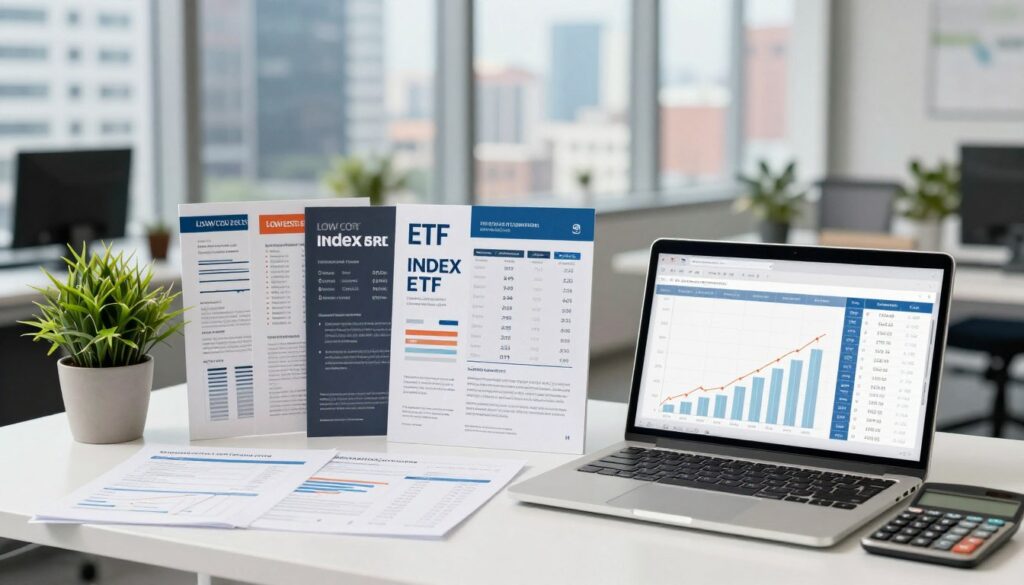
Diversification is built in. A single fund can include hundreds of companies, reducing the risk tied to any one firm. For many investors, these funds form the backbone of a long-term portfolio.
- Low fees let returns compound with less drag.
- Tracking an index keeps strategy simple and transparent.
- Broad market exposure lowers single-company risk.
“Using low-cost funds and ETFs gives you a simple, low-maintenance path toward steady growth.”
Utilizing Government-Backed Treasury Securities
U.S. Treasuries offer a low-volatility option for conserving capital while earning steady returns. These securities carry the full faith and credit of the U.S. government, making them among the safest bond choices available.
Understanding Treasury Bills and Notes
Treasury bills are short-term instruments that mature in a year or less and are sold at a discount. Notes last longer—typically two to ten years—and pay periodic interest.
Both provide a predictable stream of income and can cushion a portfolio against equity swings. Interest from these securities is exempt from state and local taxes, which can improve net returns for residents in high-tax states.
- Preserve principal: government-backed bonds protect capital while earning interest.
- Predictable income: bills and notes deliver scheduled yields for planning cash flow.
- Tax efficiency: federal securities avoid state and local taxes on interest.
- Buy directly at TreasuryDirect for direct ownership and low fees.
| Security | Typical Term | Primary Benefit |
|---|---|---|
| Treasury Bill | 4–52 weeks | Short-term capital preservation, low volatility |
| Treasury Note | 2–10 years | Steady interest payments, predictable income |
| Treasury Bond | 20–30 years | Long-term yield, strong government backing |
“Adding Treasuries can balance volatility and provide a reliable cushion during uncertain markets.”
Consider allocating a portion of your holdings to these issues if safety and steady income matter. For ideas on pairing Treasuries with other steady options, see suggestions on passive income streams.

Considering Alternative Assets and Real Estate
Real estate and other alternative assets can add useful balance to a portfolio.
REITs let you gain exposure to income-producing property without direct management. They often pay regular dividends and can act like an income stream inside a diversified plan.
Alternative investments include commodities, art, and property. These holdings tend to behave differently than stocks and bonds. That difference can reduce overall volatility and help long-term growth.

- REITs provide market access to real estate without landlord duties.
- Real estate often diversifies returns and can offer dividends plus appreciation.
- Be mindful: these investments can be illiquid and sensitive to interest rates.
| Option | Primary Benefit | Liquidity |
|---|---|---|
| Public REIT | Dividend income, easy market access | High (market-traded) |
| Private property fund | Targeted returns, less correlation to stocks | Low (lockups common) |
| Commodities & art | Inflation hedge, diversification | Variable (often low) |
Allocate a portion of your money to real estate if your goals and time horizon allow. For passive income ideas and pairing alternatives with safer holdings, see more on passive income.
“Adding tangible assets can diversify income and dampen market swings.”
Leveraging Professional Robo-Advisor Services
Let technology build and rebalance a portfolio that matches your goals. Robo-advisors use algorithms to pick funds and set allocations based on your risk profile.
Fees are low, often around 0.25% per year. That fee covers ongoing management, automatic rebalancing, and periodic tax-loss harvesting where available.
Opening a brokerage account with an automated service is a cost-effective option for hands-off investors. The platform monitors your portfolio and keeps allocations on track.

- A robo-advisor can manage your brokerage account using algorithms tuned to your tolerance and timeline.
- Choose this route if you prefer not to research individual stocks; it saves time and simplifies decisions.
- It helps keep your portfolio diversified and aligned with long-term investment goals.
For additional ideas on building passive income alongside managed accounts, see passive income ideas.
Conclusion
, Putting a clear plan around your capital sets the stage for steady growth over many years. Aim for simple steps that match your goals and comfort level.
Whether you pick a high-yield savings account or a low-cost brokerage, the important part is to start investing and keep a steady pace. You can split funds across goals so risk stays balanced.
Let your financial goals guide each choice. Review progress each year and adjust the way you allocate money as circumstances change. For extra ideas on passive streams, see passive income ideas.
FAQ
How should I start after reading "Investing ,000? Here’s What to Do"?
How do I assess my financial goals and risk tolerance?
What timeline should I use when deciding where to put money?
How can I prioritize high-interest debt repayment?
How large should my emergency fund be and where should I keep it?
What are the benefits of a high-yield savings account?
Should I use a Traditional IRA or a Roth IRA?
How important is employer 401(k) matching?
Can Health Savings Accounts (HSAs) help with retirement planning?
Why choose low-cost index funds and ETFs?
How do Treasury bills and notes fit into a portfolio?
Should I consider alternative assets or real estate with this amount?
Are robo-advisors a good option for managing a ,000 portfolio?
How do taxes affect my investment decisions?
What fees should I watch when choosing accounts and funds?
How should I build a simple portfolio with ,000?
When should I rebalance my portfolio?
Where can I open accounts for these options?


