

This friendly guide shows a clear marketing strategy you can use right away to create work that drives measurable results.
We start with goal-setting and mapping assets into a simple calendar, then move to audience choice, format selection, and promotion paths like social media and email.
Real examples—from blog planning to video distribution—will help you put ideas into practice faster and with less guesswork.
Expect actionable frameworks, checklists, and tool paths that tie every step back to business outcomes. You’ll learn how to build brand awareness, attract the right audience, and keep momentum when time is tight.
Bookmark this guide and share it with teammates who help plan and create. Ready to get started? Explore a free course to support your plan: your free course.
Key Takeaways
- Set time-bound goals and map assets into a calendar.
- Identify your audience before choosing formats like blog or video.
- Use social media and email to extend reach and measure results.
- Follow practical frameworks and checklists to save time.
- Connect each step to business outcomes for stakeholder buy-in.
Why Content Marketing Matters Right Now
People now meet brands across short clips, long reads, podcasts, and live streams throughout the day. These behaviors mean your strategy must account for how audiences hop between channels and formats.
How today’s audience consumes content across different platforms
Foleon and platform data show a pattern: LinkedIn videos during the morning commute, podcasts while people are on the go, and newsletters around lunch. This mix proves that attention is spread across social media, email, and owned sites.

- Meet people where they are: short clips drive discovery; long guides build trust and brand awareness.
- Align format to funnel stage: use social media for reach, email for nurture, and long-form for SEO depth.
- Be concise and helpful: attention is limited, so deliver clear solutions fast on each channel.
Omnichannel thinking increases familiarity without feeling repetitive. Later we’ll match formats to funnel stages so your plan turns attention into measurable outcomes. If you want a quick primer on creators and roles, see what is a content creator.
Set Clear Goals to Guide Your Strategy
Start by turning broad business aims into specific, measurable milestones that guide every post and project.
Examples of measurable goals tied to revenue, traffic, and subscribers
Pick three focus goals—revenue, organic traffic, and email growth. Use concrete targets like increasing product sales by 30%, boosting organic traffic by 20% in six months, or growing subscribers by 15% this quarter.

Mapping goals to your content calendar and channels
For each goal, list the exact posts or a recurring blog series that will move the needle. Attach deadlines, owners, and promotion channels so nothing is vague.
| Goal | Metric | Example asset | Primary channel |
|---|---|---|---|
| Increase product sales | +30% revenue | Product landing + email funnel | Email, paid media |
| Boost organic traffic | +20% sessions | Long-form blog series | SEO, organic social |
| Grow subscribers | +15% list | Lead magnet + follow-up emails | Email, onsite CTAs |
Use simple tools for tracking and run weekly check-ins to spot delays. Prioritize goals when resources are tight and document assumptions and the example assets that perform best. This keeps work focused, measurable, and tied to the audience you serve.
Know Your Target Audience Inside and Out
To reach the right people, you must learn who they are, what frustrates them, and how they prefer to consume information.
Design short surveys and focused interviews. Use SurveyMonkey or Google Forms with 6–8 clear questions. Ask about challenges, objections, and the exact questions people type or say when they search. Keep interviews to 20 minutes and record recurring themes.

Use analytics to confirm real behavior
In Google Analytics 4 go to Reports > User Attributes > Demographic details to see where your audience lives.
Then check Reports > Tech > Overview to learn preferred browsers and operating systems. Match device data to format choices like long reads or short video.
Build practical personas
Create a one-page persona that lists demographics, psychographics, business goals, core challenges, and preferred formats.
- Capture exact phrases for headlines and CTAs.
- Prioritize persona traits that affect conversion, such as media type and length.
- Run small tests to validate ideas before large investments.
Refresh personas annually. Clear profiles make cross-team collaboration easier and improve conversion when your audience feels understood.
Analyze Competitors to Uncover Content Gaps
Benchmarking rivals uncovers real opportunities you can convert into traffic and leads. Use Semrush’s Keyword Gap Tool: add your URL and up to four competitors, then click “Compare.”

Apply the Missing filter to see keywords competitors rank for that you don’t. Use the Weak filter to find terms where they outrank you. Export both lists and sort by search volume and intent.
Turn gaps into a short plan
- Tag exports by funnel stage and relevance.
- Map priority keywords to topics and product-led angles you can own.
- Assign owners and set draft due dates in your calendar; aim for high-impact pages first.
| Step | Action | Outcome |
|---|---|---|
| Compare domains | Semrush Keyword Gap → Missing + Weak | List of opportunity keywords |
| Prioritize | Sort by intent & volume | Focus on pages that drive traffic |
| Execute | Assign owner → draft → publish → promote | New or refreshed pages that close gaps |
Measure before and after and repeat this audit quarterly. Smart competitive analysis is a fast way to find what to publish next and where to spend your time.
Research Topics with Intent and Opportunity
Begin with wide topic buckets, then use tools to reveal specific queries that show clear intent. This makes it faster to find pages you can win without heavy backlinks or big budgets.

Keyword difficulty, long-tail terms, and “People also ask”
Practical steps:
- Start broad, then filter by KD% in Semrush’s Keyword Magic Tool for Easy or Very easy terms.
- Prioritize long-tail queries with clear buyer or research intent; they convert better with less effort.
- Expand Google’s “People also ask” box. Click each question to reveal more queries and copy those into a list.
Social listening for timely ideas
Use social listening on key social media and forum channels to spot hot questions and emerging angles. Tools and feeds show what people ask now and where interest is rising.
Choose what to publish:
- Score topics by intent, difficulty, and expected value (1–5 each).
- Pick items with high intent and low difficulty first.
- Capture approved topics in your calendar with format, owner, and publish date.
Quick reminder: weave short facts and visuals into outlines and revisit research monthly. For tool recommendations, see the best SEO tools.
Choose Content Formats That Fit the Funnel
Use the right media at the right stage to guide your audience from awareness to decision. Pick formats that teach first, compare next, and prove last. This approach reduces friction and speeds conversion.

Which format works where
Top of funnel (awareness): blog posts and infographics explain problems and attract search traffic. They are easy to share and raise brand familiarity.
Middle of funnel (consideration): ebooks, webinars, and podcasts help people compare options. These formats let you show depth without a hard sell.
Bottom of funnel (decision): video demos, case studies, and product guides prove outcomes. Use short demo video clips to answer final objections.
Practical pairing and checklist
- Pair a blog summary with a short video to serve different audience preferences.
- Turn one topic into a blog post, an email sequence, and a webinar replay to extend reach.
- Checklist: complexity (low/med/high), urgency (now/soon/learn), funnel stage (awareness/consideration/decision).
Track which formats keep users longer and which drive conversions. That data refines your content strategy and ensures product-led assets at decision stage feel helpful, not pushy.
Create a Content Calendar That Scales
A scalable calendar turns scattered work into a predictable rhythm teams can trust. Start with a lean plan you can run in Google Sheets or a simple board in Trello or Asana.
Map each step—research, writing, editing, design, SEO, publication, promotion—so every task shows an owner, due date, and status.
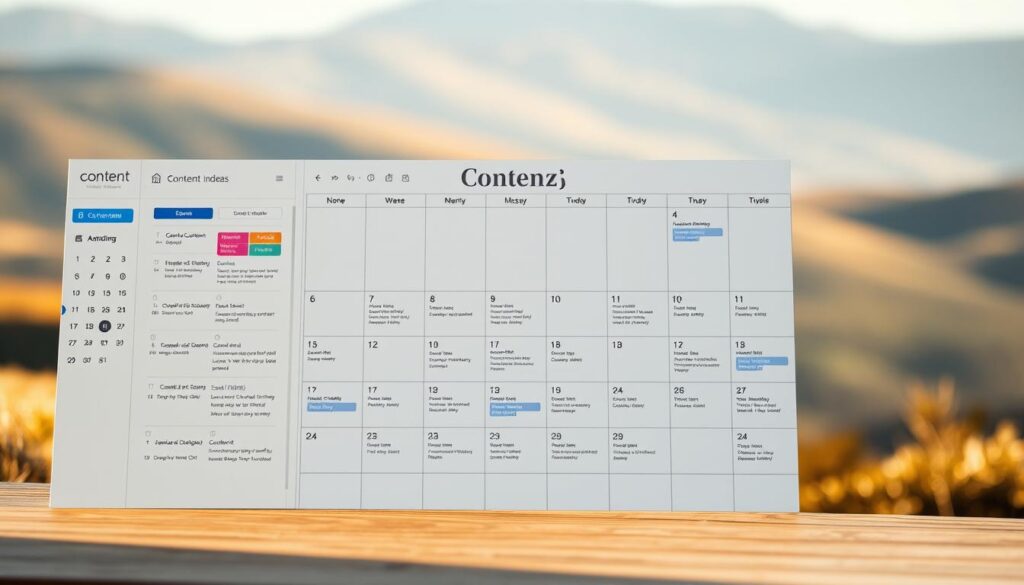
Planning workflows: research, writing, editing, design, SEO, promotion
Lay out a visible workflow so nothing slips. Use clear naming conventions: owner, stage, draft link, due date.
- Visibility: link briefs, media assets, and SEO tasks to each row.
- Approvals: block time for reviews to protect quality without slowing velocity.
- Repurpose: add a repurposing step to squeeze more value from every piece.
Balancing topics, content types, and audience segments
Balance topics, formats, and audience segments to avoid over-indexing on one area. Slot quick wins beside larger projects to keep traffic steady.
“A calendar is only useful when it ties back to your initial objectives.”
| Field | Purpose | Example |
|---|---|---|
| Owner | Clear responsibility | Jane Doe |
| Stage | Track progress | Draft / Review / Published |
| Media & SEO | Assets and tasks | Video, blog, email; meta & keywords |
Run weekly stand-ups to remove roadblocks and revisit objectives monthly. Start simple, then scale into more advanced tools as your strategy grows.
Produce High-Quality Content with E‑E‑A‑T
Lead with evidence: share experiments, results, and what you learned so readers trust the guidance. Google favors firsthand experience, and Backlinko notes that clear expertise and visible citations help pages rank. TechCrunch, for example, shows how authority scales—its backlink count reaches into the millions.

What E‑E‑A‑T means in practice
Experience = first-person case notes, original screenshots, and product trials.
Expertise = author bios, relevant credentials, and links to qualifications.
Authority = citations, original research, and pages others want to link to.
Trust = clear sourcing, recent dates, privacy and contact pages, plus reviews.
| Signal | Action | Why it matters |
|---|---|---|
| Author bio | Add credentials and links | Shows verifiable expertise |
| Original proof | Include screenshots, data, short video | Demonstrates real experience |
| Citations | Reference authoritative sources | Builds authority and link potential |
| Trust checks | Show last updated, policies, reviews | Reduces friction for readers and search engines |
Quick checklist: sources cited, expert reviewed, last updated date, support links. Track which pages earn backlinks and double down on the angles that work. E‑E‑A‑T is not a one-off task; make it a habit for every publish and update.
content marketing tips You Can Use Today
Quick wins matter when you need results fast. Focus on the posts and pages that already show promise, then amplify them in ways that cost little time but yield measurable lifts.

Quick wins: repurpose, internal linking, and refreshing old posts
Start small: find older blog posts with steady impressions and update data, visuals, and headings to improve rankings.
- Build a simple internal linking map so related pages pass authority to priority targets.
- Repurpose strong articles into short video summaries, carousels, or checklists for social media and email.
- Turn a high-performing blog into a short email series to re-engage subscribers and drive traffic back to the site.
- Add missing FAQs and snippet-friendly answers to match search intent and capture quick results.
- Improve CTAs and page layout so visitors know the next step without friction.
Track results in two to four weeks and keep a backlog of easy-refresh targets. Make these moves part of your weekly rhythm to keep steady gains in traffic and engagement.
Promote Smart: Email, Social Media, and Beyond
Smart promotion matches message to the channel and the moment. Use email to nurture, social posts to attract, and partnerships to expand reach. Track results so you invest where your audience responds.

Email newsletters that add value, not just pitches
Send helpful sequences: educational notes, templates, and short stories that readers expect. Include one clear CTA per message that leads to a guide or product page without hard selling.
Social snippets and channel fit by audience
Match tone and length: Instagram for visuals, LinkedIn for long insight, TikTok for short video, and Pinterest for evergreen visuals. Keep posts native to each platform and link back to your asset.
Guest posts, PR, influencers, and syndication
Use guest posting and PR to reach new readers. Partner with influencers for credibility. Syndicate selected pieces on Medium or republish excerpts when it won’t cannibalize your site.
| Channel | Best use | Quick metric |
|---|---|---|
| Nurture & conversions | Open & click rate | |
| Social media | Reach & engagement | Impressions & shares |
| PR/Partners | New audience & backlinks | Referral traffic |
Practical steps: run GA User Acquisition, scan competitor channels with Semrush, keep a promotion checklist per publish, and build evergreen swipe copy your team reuses.
For idea prompts and ready-made sequences see this useful prompt collection.
Measure What Matters with Google Analytics and Search Console
Measurement turns guesswork into a plan by showing which channels bring real visitors and conversions. Set a simple tracking layer first so your team focuses on a tight set of KPIs and not every metric under the sun.

Key metrics to track
Define a focused set of KPIs: organic sessions, rankings, conversions, and engagement. Backlinko recommends pairing Google Analytics with Search Console to watch organic traffic, keyword performance, and social engagement.
Use acquisition and channel data to refine strategy
Check GA’s User Acquisition to see which channels—Organic Search, Social, Direct, Referral—bring qualified visitors and repeat visits. Tag campaigns and link email metrics to on-site goals so you know which messages convert.
- Step: weekly top-line review, monthly deep-dive, quarterly strategy adjustments.
- Use Search Console query data or a rank-tracking tool (Semrush can track up to 10 keywords on a free account) to spot wins and early declines.
- Add video metrics to dashboards when video is core to your mix.
Document insights and next actions. Capture the key questions your data raises and run small tests—headlines, intros, or internal links—to answer them. Measurement isn’t perfection; it’s how you improve your aim each cycle.
“If you can measure it, you can improve it.”
Map and Audit Content Across the Customer Journey
Inventorying your assets across stages reveals where to refresh, repurpose, or retire material.
Start with a simple spreadsheet that lists each asset’s status, type, title, journey stage, persona, and URL. Foleon recommends these fields because they make gaps visible at a glance.

Identifying gaps from awareness to decision
Tag every page or blog by stage: Awareness, Consideration, Decision, and Post-purchase. Then flag thin or outdated pieces for review.
Thin pages become idea seeds: refresh examples, add data, or combine into longer guides that serve search and people better.
Assigning goals to each asset for optimization
Give each piece one primary goal—Acquisition, Activation, Education, Revenue, Expansion, or Referral. This clarity helps teams prioritize updates that move metrics.
- Score impact and effort (1–5) so high-impact, low-effort pages rise to the top.
- For BOFU, add product-led assets that demonstrate outcomes without overselling earlier stages.
- Pair every planned update with a short re-promotion plan: email blurb, social snippet, and internal link push.
- Identify high-potential pages using traffic and conversion data.
- Improve structure: clear headings, examples, and a single strong CTA.
- Publish, track metrics, and record naming conventions so next quarter’s audit is faster.
| Field | Example | Why |
|---|---|---|
| Stage | Consideration | Shows role in journey |
| Primary Goal | Activation | Aligns updates to outcomes |
| Score | Impact 5 / Effort 2 | Prioritize work |
Revisit the audit quarterly and track movement in key metrics after changes. Small, regular updates keep your strategy nimble and aligned to audience questions and topics.
Define Brand Voice and Governance for Consistency
A clear brand voice and simple governance stop guesswork and speed up every publish cycle. When everyone knows the rules, teams move faster and readers see a steady, trustworthy presence.

Start small: write one-page rules that describe tone, preferred words, formatting, and a few quick examples. Backlinko advises a governance policy that covers approval, social rules, quality standards, and update schedules to protect E‑E‑A‑T as you scale.
Style guides, approval workflows, and update schedules
Document a style guide that shows tone, word choice, and formatting. Include one or two short examples so writers match the brand across formats.
- Outline an approval workflow that names owners and expected review time so quality does not slow production.
- Set an update schedule for high-traffic and high-intent pages so pages stay accurate and useful.
- Write social guidelines that adapt the brand voice per channel while staying recognizable.
Train new people with templates, checklists, and a short onboarding checklist. A posts review loop should check titles, intros, and CTAs before publish.
“Good governance saves time later by reducing rework and confusion.”
| Role | Responsibility | Cadence |
|---|---|---|
| Author | Draft & fact-check | Per draft |
| Editor | Tone & style review | 24–48 hours |
| Owner | Final approval & publish | Weekly |
Example governance table like the one above helps teams copy a simple setup and get going quickly. Clear rules tied to E‑E‑A‑T—citations, author bios, and review cadence—keep the brand reliable as you scale.
Tools and Examples to Get Started Faster
A compact tech stack and a few real examples will get you publishing steadily in days, not weeks.

Starter stack: Google Sheets for a shared content calendar, Trello or Asana for workflows, and Semrush for research (Keyword Magic, Keyword Gap, Position Tracking, Traffic Analytics).
Quick calendar template
Use a sheet with these columns: Title, Owner, Due date, Status, Primary channel, KPI. Fill rows for blog posts, video, email, and social media promos so every asset shows who owns next steps.
Research workflow in three steps
- Run Keyword Magic to find topic clusters and filter by KD (easy/medium).
- Use Keyword Gap to spot competitor gaps; export top choices by intent and volume.
- Prioritize pages with high intent and low difficulty; add them to the calendar with owners.
Example competitor snapshot
| Action | Tool | Result |
|---|---|---|
| Find missing queries | Keyword Gap (Semrush) | List of target topics your rivals rank for |
| Track priority pages | Position Tracking | Daily SERP changes and keyword trends |
| Check competitor channels | Traffic Analytics | Referral and social breakdown for ideas |
Light video workflow: 1) short script (bullet outline), 2) single-camera capture, 3) quick edit (trim, captions), 4) upload with a timestamped description and CTA. Repeatable templates help teams film weekly.
Keep briefs tidy: goal, audience, top 3 messages, keywords, CTA, and sample H2s. Save snippets and social copy in one sheet so emails, blog posts, and social media promos attach to each asset without rewriting.
“Use simple systems you can sustain. Consistency beats complexity.”
Weekly tools routine: sync research exports, update position tracking, refresh the calendar, and reassign any stalled tasks. Small, steady habits keep work moving and reduce scramble before launches.
Conclusion
Finish with a simple, repeatable playbook: set one measurable goal, define your target audience, then pick the right content formats for each funnel stage across different platforms.
Plan promotion as part of creation: schedule email, social media, and a quick PR or partnership step before you publish so distribution is never an afterthought.
Use Google Analytics and a small dashboard to watch the few metrics that matter. Back strong, evidence-led work with E‑E‑A‑T so great content earns trust and traffic over time.
Quick start: choose one priority topic, ship one strong blog post or video, learn from data, then iterate—refresh posts, test headlines, and repurpose into social. For a practical how-to on building your site, see how to make a website.
Now schedule your next planning session and commit to a steady cadence of new pieces. Small, regular steps beat big, sporadic efforts every time.
FAQ
What are the first steps to build an effective content strategy?
How do I find topics that will actually drive traffic and conversions?
Which content formats work best for different stages of the funnel?
How often should I publish and how do I scale a calendar?
What metrics should I track in Google Analytics and Search Console?
How can I improve discoverability without relying solely on SEO?
What role does audience research play in content decisions?
How do I maintain a consistent brand voice across channels?
What tools speed up research and calendar planning?
How do I ensure my work demonstrates expertise and trust?
What quick wins can I implement this week?
How do I analyze competitors to find content gaps?


