

Connect your brand to people on the platforms they already use. Platforms like Instagram, X, Facebook, LinkedIn, Pinterest, YouTube, and TikTok turn attention into awareness, engagement, and measurable growth.
Now is the moment to act. Competition is higher and algorithms favor relevant, short-form video and edutainment. A clear content strategy aligned to business goals helps you prioritize efforts and show ROI with reach, impressions, engagement, clicks, and conversions.
Think of this as part of digital marketing that drives revenue, pipeline, and lifetime value—not vanity metrics. We’ll cover goals, KPIs, audience insights, audits, pillars, calendars, video best practices, and reporting leaders trust.
Use data, not guesswork. Track reach, share of voice, and conversions to benchmark success. Combine organic community building, paid amplification, and influencer partnerships to multiply results and cut time to impact.
Key Takeaways
- Platforms meet people where they already spend time; that turns attention into growth.
- Short-form video and edutainment boost visibility when paired with a focused strategy.
- Align campaigns to business outcomes—revenue, pipeline, and customer value.
- Measure reach, engagement, clicks, and conversions to prove ROI.
- Blend organic, paid, and influencer tactics for faster, scalable results.
What Is Social Media Marketing and Why It Matters Right Now
Brands use platform-driven channels to tell stories, build trust, and turn attention into measurable outcomes. This approach combines creative content and analytics to reach customers where they already spend time online.

Defining the channel: platforms, content types, and interactions
Social media marketing is the use of platforms and websites to promote products and services, engage customers, and reach new audiences. It includes short-form video, carousels, Stories, long-form video, live streams, polls, user-generated posts, and links—each format drives different outcomes.
Proactive publishing means planned posts and campaigns. Reactive engagement covers replies, DMs, and comments that shape perception and loyalty.
The present landscape in the United States
In the U.S., cross-generational consumers interact with brands on social channels. Instagram, for example, reaches 84% of social users and helps 61% discover purchases.
“User-generated content often outperforms brand-only posts for authenticity and trust.”
Platforms offer built-in analytics so businesses can track reach, impressions, clicks, and engagement in real time. A strong strategy blends education, entertainment, and utility to win attention and time on feed.
- Why it matters now: Rapid shifts in behavior mean companies that adapt content and cadence gain share of attention.
- How it fits: social media marketing complements digital marketing to drive traffic, capture emails, and support the full funnel.
What’s New in 2025: Trends Shaping Your Social Media Strategy
In 2025, short-form clips and creator-led lessons are rewriting how brands win attention online.

Short-form video and edutainment as engagement drivers
Short clips dominate because they are fast, native, and favored by algorithms. Platforms reward completion rate, watch time, and saves, so concise hooks matter.
Edutainment blends teaching with entertainment to boost shares and repeat views. That repeat viewing fuels discovery and higher reach.
Influencer integration for multi-channel distribution
Brands now repurpose creator assets across paid ads, email, landing pages, and retail placements. Whitelisting and clear licensing let marketers scale high-performing assets legally and fast.
Algorithm-driven discovery and the rise of social search
Discovery is interest-driven, not follower-driven. Optimizing captions, keywords, and on-screen text improves intent-led queries like “best running shoes” or “how to budget.”
“Data signals—watch time, comments, and shares—tell the algorithm which clips to amplify.”
| Trend | Why it Matters | Action |
|---|---|---|
| Short-form video | High reach; rewards completion | Test hooks in first 3 seconds; measure watch time |
| Edutainment | Boosts saves and shares | Create tutorials and myth-busting clips |
| Creator integration | Higher authenticity and ROI | Use whitelisting and reuse assets across channels |
| Social search | Intent-led discovery | Optimize captions and on-screen keywords |
Testing framework tip: run agile sprints, try duets, tutorials, and product try-ons, then iterate on what lifts watch time and conversions.
Benefits That Move the Needle for Your Business
Purposeful online presence turns attention into leads, loyalty, and measurable revenue. A well-defined social media strategy increases brand awareness and engagement. Consumers rank authenticity among top traits they value.

Brand awareness, authenticity, and community building
Awareness that sticks matters. Authentic content, creator partnerships, and employee advocacy build trust and long-term affinity.
Employee advocacy can extend reach fast—Simpli.fi earned $90,000 in earned media value in three months through advocacy.
Lead generation, social commerce, and revenue impact
Use downloadable guides, webinars, and UTM-tagged links to track leads into pipeline. Social commerce and product catalog integrations close the loop from discovery to purchase.
Customer service advantages and speed-to-resolution
Public replies improve transparency and speed up first-response time. Fast resolution reduces churn and creates visible proof of care.
- Measure: UTM links, promo codes, and share-of-voice tracking to quantify impact.
- Build community: AMAs, UGC contests, and localized groups that encourage advocacy.
How to Build a Social Media Strategy That Aligns with Business Goals
Start by mapping each business objective to specific channels and measurable actions. Translate revenue targets, retention goals, or employer-brand aims into channel-level outcomes so the team knows what to prioritize.

Pick metrics that prove impact. Use reach and impressions for awareness, engagement rates for resonance, and conversions and ROAS for acquisition. Tie those KPIs into pipeline dashboards so leaders can see value beyond likes.
Translate business objectives into channel goals
Define audience hypotheses by persona and platform. Match content formats and posting cadence to where each group spends time and how they prefer to consume.
Choose success metrics that prove ROI
Build governance: who creates, approves, publishes, and responds. Set boundaries for time and expertise so work stays efficient and compliant.
- Align resourcing: in-house, agency, creator partners, and tooling.
- Use listening tools to track share of voice and identify white space.
- Create feedback loops from analytics to creative to improve hooks and offers fast.
Document a decision framework for paid vs. organic vs. influencer plays and establish a quarterly planning cadence with monthly optimization cycles. This keeps the strategy focused, measurable, and tied to business results.
Set Goals and KPIs You Can Actually Measure
Start by naming the outcomes you care about and map metrics to each step of the funnel.
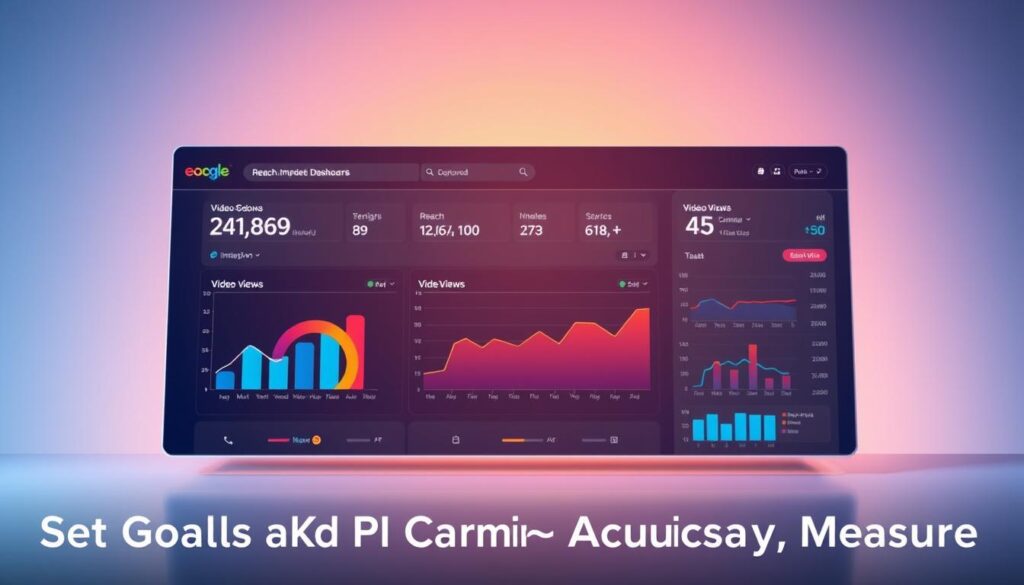
Awareness needs scale and cultural signal. Track reach, impressions, video views, and hashtag performance to understand how broadly content travels and whether it lands in relevant conversations.
Engagement that reflects interest
Monitor likes, comments, saves, shares, and clicks. These show content-market fit and indicate what to amplify.
Acquisition you can attribute
Measure conversions, conversion rate, ROAS, and influencer ROI. Use UTMs and promo codes so every conversion links back to the right campaign.
“Good KPIs are specific, measurable, and tied to business outcomes.”
- Define a KPI framework mapped to awareness, engagement, and acquisition so teams know what good looks like.
- Set channel targets by using past performance and industry benchmarks for your audience and brands.
- Use dashboards to roll up metrics into business-level outcomes that leaders trust.
- Establish alerts for leading indicators (for example, falling watch time) to trigger quick adjustments.
- Include cohort analysis and qualitative signals from comments and DMs to inform messaging and offers.
Review KPIs weekly, monthly, and quarterly. Fast checks enable iteration; longer reviews reveal trends that shape strategy and success.
Know Your Audience: Data-Backed Personas and Communities
Audience-first planning uses real data so each piece of content finds the right people at the right time.
Listening tools and platform analytics reveal demographics, interests, and behaviors. Use that information to build personas that match actual users, not assumptions.

Demographics, interests, and behaviors by platform
Map where each persona spends time and what they consume. Short clips often win on TikTok and Instagram, while LinkedIn reaches professionals and YouTube serves deep how-tos.
- Young audiences: short-form video, high frequency.
- B2B buyers: LinkedIn posts, case studies, and webinars.
- Searchers: YouTube tutorials and long-form explainers.
US-specific nuances and accessibility considerations
In the U.S., privacy rules and regulated sectors shape what you can say. Healthcare teams must avoid discussing personal care publicly and instead guide users to secure channels.
- Add captions, alt text, clear contrast, and readable fonts.
- Track shifts in behavior with social search and adjust cadence.
- Validate personas with small tests before scaling to full campaigns.
Audit Your Current Social Media and Competitive Landscape
Start your audit by collecting performance data across every channel to see what truly drives engagement and conversions. A focused review turns noise into a clear plan so teams spend time on what works.

Content audit: wins, gaps, and redundancies
Inventory every channel and post type. Track themes, formats, and platforms to spot repeatable winners and stale assets that waste resources.
Check tagging, UTMs, and pixels so every campaign can be measured. Identify depth gaps across awareness, consideration, and decision stages.
Competitive analysis: share of voice and differentiation
Use listening tools to benchmark share of voice and sentiment. Map competitor campaigns and ads to see where they invest and which hooks work.
Document a prioritized action list: stop, start, continue—tied to KPIs for the next two quarters. Establish a recurring audit cadence so your strategy evolves with audience behavior and algorithms.
- Review governance and management workflows to remove bottlenecks.
- Analyze performance by theme and platform to retire or rework low performers.
- Use sentiment and competitive data to refine positioning and offers.
For broader context on channel benchmarks and trends, see digital marketing statistics.
Plan Your Content Strategy and Calendar
A clear calendar turns ideas into consistent content that moves people through the funnel. Start by mapping themes to the customer journey so every post has a purpose.

Content pillars mapped to customer journey
Define 3–5 pillars that cover awareness, education, proof, product, and brand values. These pillars guide briefs and make creative faster to produce.
When pillars align to stages, you avoid gaps between discovery and purchase. That helps your team focus on measurable outcomes for each piece of content.
Posting cadence, timing, and cross-channel coordination
Use scheduling tools and optimal send-time features to keep cadence steady and reach high. Balance always-on posts with campaign bursts to limit audience fatigue.
Coordinate themes across platforms so messages ladder to one idea while respecting each channel’s native format.
Using employee advocacy to expand reach
Employees amplify reach and often drive higher engagement than brand-only posts. Provide ready-to-share assets and simple scripts so people can personalize authentically.
- Create modular assets that scale—from 6-second hooks to 60-second explainers.
- Set creative guardrails: hook frameworks, on-screen text rules, and caption styles.
- Include measurement checkpoints in the calendar to evaluate pillar performance and iterate fast.
Video Marketing and Creative Best Practices
Great video starts with an idea that hooks in under three seconds. Short-form storytelling is the fastest way to reach people who scroll quickly. Keep edits tight and your message clear so viewers stay to the payoff.
Short-form storytelling for platforms like Instagram and TikTok
Lead with motion or a bold question to stop the scroll. Use a simple arc: problem, payoff, proof. That structure works for vertical viewing and quick attention spans.
- Open in 1–3 seconds with a visual hook.
- Keep runtime short and focus on one idea per clip.
- Mix product shots with real people and behind-the-scenes for trust.
Edutainment formats that boost watch-through and shares
Tips, myths vs. facts, and how-tos drive saves and replays. On-screen text and captions help silent viewers and improve accessibility.
“Edutainment turns useful content into discoverable moments that algorithms amplify.”
| Focus | Why it Works | Action |
|---|---|---|
| Hook (0–3s) | Stops scroll; increases initial retention | Use motion, question, or bold claim |
| Structure | Keeps viewers engaged to the payoff | Problem → Payoff → Proof |
| Diagnostics | Shows where to iterate | Track hook retention and rewatch rate |
| Repurposing | Scales creative across channels | Secure rights; edit to platform tone |

Organic, Paid, and Influencer Plays That Work Together
Blend slow-burn community building with fast-test paid plays to maximize impact. Organic content deepens relationships and uncovers what resonates. Paid campaigns scale winners quickly and fund rapid learning.
Use paid when speed or reach matters: support launches, target lookalikes, and test creative at scale. Paid advertising also lets you control frequency and measure conversions fast.
When to amplify vs. nurture community
Run small organic tests to validate hooks and offers. Once a concept lifts engagement, move it into paid to reach broader audiences.
Reserve organic efforts for voice, customer care, and long-term trust that paid alone can’t buy.
Influencer and UGC campaigns for trust and scale
Sponsored creator content often outperforms brand-only posts in engagement. Negotiate usage rights so you can repurpose top-performing clips in ads, email, and landing pages.
Design UGC prompts with clear instructions and incentives, then curate the best submissions to showcase authentic proof to consumers.
“UGC acts like earned media—authentic, scalable, and cost-effective when paired with paid amplification.”
- Segment campaigns by objective: reach, engagement, or conversion, and match bidding to each goal.
- Use audience stacking and exclusions to reduce waste and control frequency across placements.
- Track creator vs. brand asset performance to shift budget where success is proven.

| Play | When to Use | Key Benefit | Action |
|---|---|---|---|
| Organic community | Brand building; support; long-term trust | Authenticity; low cost per engagement | Test messaging; nurture followers; host AMAs |
| Paid campaigns | Launches; rapid testing; conversion pushes | Speed; precise targeting; measurable ROAS | Scale winning creative; use retargeting sequences |
| Influencer & UGC | Authenticity; social proof; creative variety | Higher engagement; repurposeable assets | Negotiate rights; curate submissions; disclose partnerships |
For a broader view on how these elements fit into a full digital plan, see digital marketing strategies.
Delivering Customer Service on Social
Fast, clear replies on public channels shape how customers view your company in minutes. Response time and tone directly influence brand trust. Many brands add customer care into their overall strategy to meet expectations in real time.

Response time, tone, and escalation workflows
Set channel-specific targets—example: answer within one hour during business hours—and use queues to prioritize urgent issues.
Define tone guidelines focused on empathy, clarity, and professionalism. Short, human replies work better than corporate scripts.
Map triage rules so front-line staff escalate to support, legal, or PR with clear SLAs and ownership.
Managing privacy, regulated communications, and handoffs
Protect customer privacy at every step. Never request sensitive information publicly; move conversations to secure channels like email, chat, or your CRM.
Document compliance protocols for regulated industries (for example HIPAA rules in healthcare) and train teams to follow them.
“A prompt public acknowledgement plus a private resolution builds trust with both the complainer and observers.”
- Create macros and knowledge-base links for common questions, then personalize each reply.
- Track response time and CSAT or sentiment to measure service impact on brand perception.
- Monitor mentions and set alerts for spikes in negative sentiment or defects.
- Close the loop publicly when issues are resolved to show accountability.
For practical tools to manage queues and publishing, see our response tools comparison.
Tools and Teams: Social Media Management Essentials
A compact tool stack and clear roles keep campaigns steady and accountable. Use scheduling for reliability, listening for voice-of-customer, analytics for performance, and an asset library for brand consistency.

Scheduling, listening, analytics, and collaboration
Scheduling ensures posts go out on time and frees up creative time for the team.
Listening surfaces trends, sentiment shifts, and competitor moves so content stays relevant.
- Core stack: scheduler, listening platform, analytics dashboard, and asset library.
- Workflows: approval gates reduce risk, keep tone on-brand, and save time for stakeholders.
- Standardization: UTM templates and shared dashboards make data roll up clean into business reports.
- Roles: strategists, community managers, analysts, and creators with defined ownership.
- Integration: connect CRM and help desk to tie interactions to customer records.
- Governance: access controls, two-factor authentication, and permissioned accounts protect the company.
- Vendor review: watch roadmaps and AI features, but keep human judgment in the loop.
- Measure ROI: track time saved, faster response time, and better decisions reflected in campaign results.
“Good tools let teams spend less time on ops and more time on strategy and results.”
Data, Listening, and Insights to Inform Smart Decisions
Listening to what customers say online turns scattered chatter into clear, actionable business signals. Use unfiltered conversation data to spot trends, favorites, and areas where your products or messaging miss the mark.

Sentiment analysis and real-time trend detection
Sentiment analysis classifies mentions as positive, negative, or neutral so teams can prioritize responses and messaging quickly.
Real-time trend detection surfaces creator-driven moments and spikes in interest. That lets your team create timely content that fits the moment and gains traction.
Turning conversations into product and messaging insights
Map listening outputs to product roadmaps and campaign briefs. Translate common complaints into feature requests and common praise into proof points.
- Track brand, category, and competitor mentions to find themes consumers care about now.
- Use sentiment scores to guide tone, offers, and prioritization.
- Capture customer language so copy and creative sound native to your audience.
- Combine quotes with metrics to create leadership-ready insight reports.
Ethics and process: set clear guidelines for public-data use, and run repeatable insight sprints—pull, synthesize, recommend, test—to keep strategy grounded in reality.
For tactical execution and writing that converts, see our sales copywriting guidance.
Measuring ROI and Reporting That Leaders Trust
Good reporting turns content activity into boardroom-ready business outcomes. Build dashboards that connect reach, engagement, clicks, conversions, and ROAS to pipeline and revenue so leaders see clear impact.

Dashboards that tie KPIs to pipeline and revenue
Design executive dashboards with pipeline rows and revenue columns. Show campaign-level KPIs alongside conversion rates and dollar value attributed to each touch.
Be explicit about assumptions. Note which attribution model you used and why.
- Track referral traffic: use UTMs and consistent naming to link landing pages to conversions.
- Segment by campaign and creative: spot which assets move leads into pipeline fastest.
- Include influencer and employee advocacy: quantify earned media value and revenue contribution from creator programs.
Attribution, referral traffic, and share of voice tracking
Select attribution models—first-touch, last-touch, or multi-touch—that match your buying journey and document those choices.
Combine referral analysis with multi-touch modeling to avoid overcrediting a single channel. Add share of voice and sentiment as leading indicators of future demand.
“Report learnings, not just numbers: recommend what to scale, stop, or test next.”
Set a cadence: weekly operational checks, monthly performance reviews, and quarterly strategy sessions. Run regular audits of pixels, tags, and integrations so every insight is trustworthy.
social media marketing
social media marketing uses networked platforms to build brand equity, drive demand, and create customer relationships.
It sits inside broader digital marketing and marketing communications, complementing SEO, email, and paid channels to move people through the funnel.
The real power comes from connection, interaction, and customer data that inform smarter creative and targeting.

Typical use cases include audience-targeted ads, creator partnerships, user-generated content (UGC), community programs, and service support. These tactics boost reach and make the buyer journey measurable.
Benefits and trade-offs: high exposure and cost efficiency often come with the need for consistent publishing and careful reputation management. Real-time feedback can be a strength—but it must be handled quickly and with care.
- Must-haves: clear goals, robust measurement, audience insights, content pillars, and agile optimization.
- Team alignment: combine people and tools so the platform work ties to conversions and business KPIs.
“Success compounds when content, community, and conversion paths are integrated and tracked.”
Conclusion
Finish strong: set clear goals, measure what matters, and make faster decisions from real data.
Recap the playbook: align goals to business outcomes, define KPIs, know your audience, and build a steady content calendar with clear pillars. Prioritize short-form video, edutainment, and creator-led work to speed discovery and trust.
Use paid, organic, and influencer tactics together, guided by testing and the insights you collect. Operationalize with the right team, tools, and governance so work runs reliably and safely.
Listen continuously to customers and turn conversations into product and message improvements. Report with dashboards that link reach, engagement, and conversions to revenue so leaders see real success.
Start your audit, set measurable goals, and publish your next piece of content with intent today. Learn practical steps in our free course.
FAQ
What is social media marketing and why does it matter now?
Which platforms and content types should my business prioritize?
How can short-form video help my brand in 2025?
How do I measure success and prove ROI?
What KPIs should I track for engagement and acquisition?
How do I build audience personas that actually work?
What does a content audit involve?
When should I use paid ads versus organic efforts?
How can influencer and user-generated content amplify campaigns?
What are best practices for delivering customer service on platforms?
Which tools should my team use to manage publishing and analytics?
How do listening and insights inform product and messaging decisions?
What legal or privacy issues should I consider on platforms?
How frequently should I post and what cadence works best?
How can employee advocacy expand reach?
What trends in 2025 should brands prepare for?


